
A Question Worth Asking Before You Book Any Tour
January 25, 2025 · by Roselin Alvarez
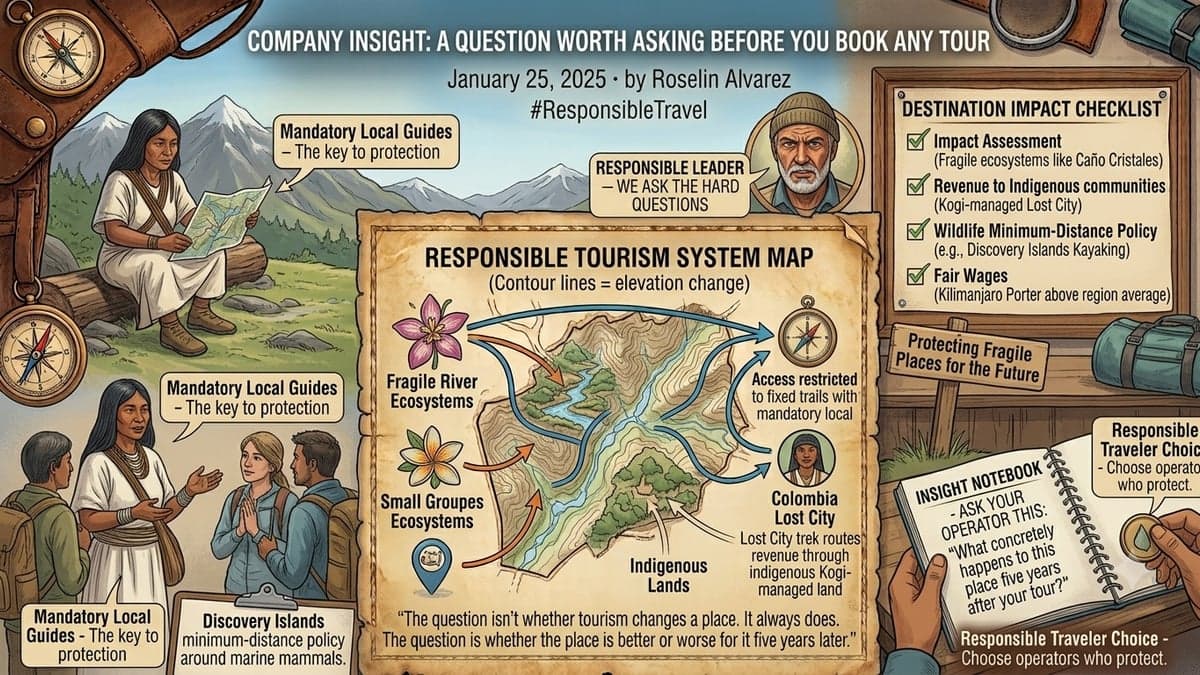
Before we add a new destination to the catalogue, we ask one question that's uncomfortable enough that most companies skip it: what happens to this place because we bring people to it?
Why Caño Cristales runs in small groups only
Caño Cristales — the "river of five colours" in Colombia — is a fragile ecosystem. The plant responsible for its famous colours, Macarenia clavigera, can be damaged by foot traffic and touch. That's why access is restricted to fixed trails with mandatory local guides, and it's why we cap our groups at ten people rather than the larger numbers some operators run. The short-term cost is a smaller, slightly more expensive trip. The alternative is a river that stops turning colours.
"Sustainable" shouldn't be a marketing word
We're wary of how loosely the word "sustainable" gets used in travel marketing, ourselves included at times. What we can say concretely: our Kilimanjaro crews are paid above the region's typical porter wage, our Lost City trek in Colombia routes revenue through indigenous Kogi-managed land, and every wildlife-focused trip — the Discovery Islands kayaking route especially — follows a minimum-distance policy around marine mammals that our guides won't break even when a group asks them to get closer.
The question isn't whether tourism changes a place. It always does. The question is whether the place is better or worse for it five years later.
What this means for you as a traveler
None of this requires you to do anything differently — it's built into the itinerary before you ever book. But if a tour operator can't tell you concretely what their answer to this question is, in any destination, that's worth asking about directly.